
When a CEO tells me revenue isn’t growing the way it should, my first response isn’t to talk about sales. It’s to ask a different question: Do you know exactly where in the system the breakdown is occurring?
Most companies don’t. And that’s the real problem.
Over more than two decades working inside large corporations, advising growth-stage companies, and participating in think tank sessions with the Institute for the Study of Business Markets at Penn State University, I’ve reached a clear conclusion: revenue underperformance is almost never a single-point failure. It’s a system failure. And you can’t fix a system you haven’t mapped.
That’s what led me to develop Revenue Architecture — A Market Resonance System.
This framework is built specifically for B2B. In business-to-business environments, you have defined segments, finite target lists, and complex buying processes involving multiple stakeholders — each with different priorities, different concerns, and different definitions of value. That complexity is exactly why a structured, integrated architecture matters so much.
THE DIAGNOSTIC MINDSET
Think about what happens before a commercial aircraft takes off. The crew doesn’t assume the plane is ready. They work through a preflight checklist — methodically verifying every system. Avionics. Hydraulics. Navigation. Fuel. Engines. Each one is a discipline unto itself, with its own specialists and its own failure modes. Every single one must be confirmed before the aircraft moves.
Now ask yourself: when did your company last run a preflight checklist on its revenue system?
No single system flies the plane. It’s the integration of interdependent systems — each handing off to the next — that makes flight possible. When something goes wrong, investigators don’t guess. They pull the data, trace the failure back to its precise origin, and fix it there.
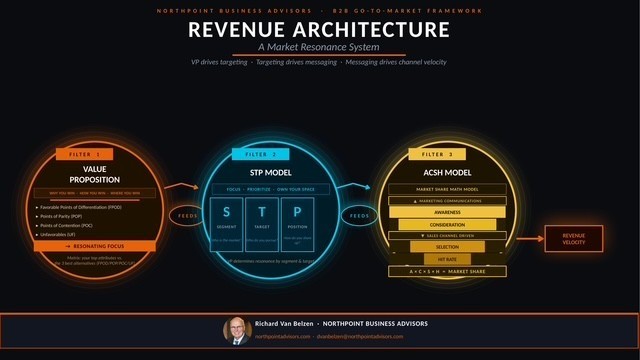
Revenue works exactly the same way. What I’ve built is the preflight checklist for B2B revenue — three integrated filters, each one feeding the next.
FILTER 1: VALUE PROPOSITION
This is the foundation. Everything downstream depends on it — and yet it’s the component most companies treat as settled when it’s anything but.
A strong value proposition isn’t a tagline. It’s a living set of inputs:
- Favorable Points of Differentiation (FPOD) — where you genuinely win and why
- Points of Parity (POP) — the category table stakes you must meet
- Points of Contention (POC) — the objections and friction points that must be addressed
- Unfavorables (UF) — an honest acknowledgment of where you don’t win and why
Together, these produce what I call the Resonating Focus: the specific combination that connects with a given customer, in a given context, at a given moment. A diagnostic tool I use is a matrix that maps your top attributes against your three best alternatives across all four dimensions — it reveals very quickly where your real advantage lives and where you’re vulnerable.
The same value proposition does not land the same way with every audience. An engineering team cares about different things than a CFO. A purchasing manager has different concerns than a CEO. Filter 1 is where you identify, validate, and tune those levers — continuously. When the economy shifts, buyers move from wanting to needing. Your differentiation story has to shift with them.
FILTER 2: STP MODEL — SEGMENT, TARGET, POSITION
Once your value proposition is well-honed, you can map it against the market with precision.
Segmentation asks: Who is the market? Targeting asks: Who do we pursue within it? Positioning asks: How do we show up in a way that resonates with that specific target?
That last question is only answerable if Filter 1 is solid. This is the interdependency that most companies miss. Ad agencies and marketing teams so often struggle because they’re building campaigns for targets they haven’t precisely defined, with positioning that hasn’t been validated against a rigorous value proposition foundation. The STP model, built on Filter 1, solves that.
The STP model is what drives your messaging. Get it right, and everything in Filter 3 becomes more efficient.
FILTER 3: ACSH MODEL — AWARENESS, CONSIDERATION, SELECTION, HIT RATE
This is where the market share math lives — and where the two primary commercial functions become visible as a single system.
Awareness and Consideration are the domain of marketing communications. They are driven by how well your messaging resonates with your targets — which flows directly from Filter 2.
- Awareness — what percentage of your B2B target market knows you exist? In a market of 25 accounts, this is very measurable. In a software company with thousands of potential customers, it requires a deliberate strategy.
- Consideration — a buyer can be aware of you and still choose not to evaluate you, because of a past experience, a pricing perception, or messaging that didn’t connect. Strong STP work improves consideration rates directly.
Selection and Hit Rate are channel and sales driven. But notice something important: by the time a buyer reaches selection, your sales team is operating on the foundation built in Filters 1 and 2. The channel doesn’t create opportunity from nothing — it converts opportunity that marketing has developed.
- Selection — of everything a buyer is considering, you need to be on the short list.
- Hit Rate — the final close. The percentage of selection opportunities that convert to revenue.
The math is elegant: A × C × S × H = Market Share. Improve any single variable and the whole equation improves. The diagnostic power is in knowing which one is actually limiting you — and tracing that constraint back to its upstream source.
THE SYSTEM THAT CONNECTS THEM
Your channel velocity is bounded by your messaging quality. Your messaging quality is bounded by your targeting precision. Your targeting precision is bounded by your value proposition.
That’s the architecture. And it’s why I call it Revenue Architecture — not a collection of frameworks, but a single integrated system where each filter feeds the next.
Each component — the Value Proposition model, the STP model, the ACSH model — is built on proven, time-tested frameworks with repeatable, productive results. What I’ve done over 20+ years is integrate them into a single overarching architecture. Because they only reach their full power when they work together as a total system.
I’ve seen companies invest millions in sales compensation, CRM systems, and advertising while the actual constraint was an unvalidated value proposition from a decade ago that no longer mapped to how the market was buying. The diagnostics reveal this. The system fixes it.
No airline would board passengers without a verified preflight. Yet companies launch into B2B markets, hire sales teams, and run campaigns every day without confirming their revenue systems are airworthy.
If your revenue isn’t lifting the way you want it to, the answer is almost never “sell harder.” It’s “diagnose better — starting at the foundation.”
That’s what Revenue Architecture is built to do.
Richard Van Belzen is the founder of NorthPoint Business Advisors, a management consulting practice specializing in B2B go-to-market strategy, revenue diagnostics, and commercial performance. He has advised companies across industries for over 20 years.
Which of the three filters is the biggest challenge in your business right now? I’d welcome the conversation in the comments.